
A comprehensive walkthrough of Andrej Karpathy's microGPT: the "most atomic" GPT implementation using pure Python and math only — no PyTorch, no NumPy, no GPU.
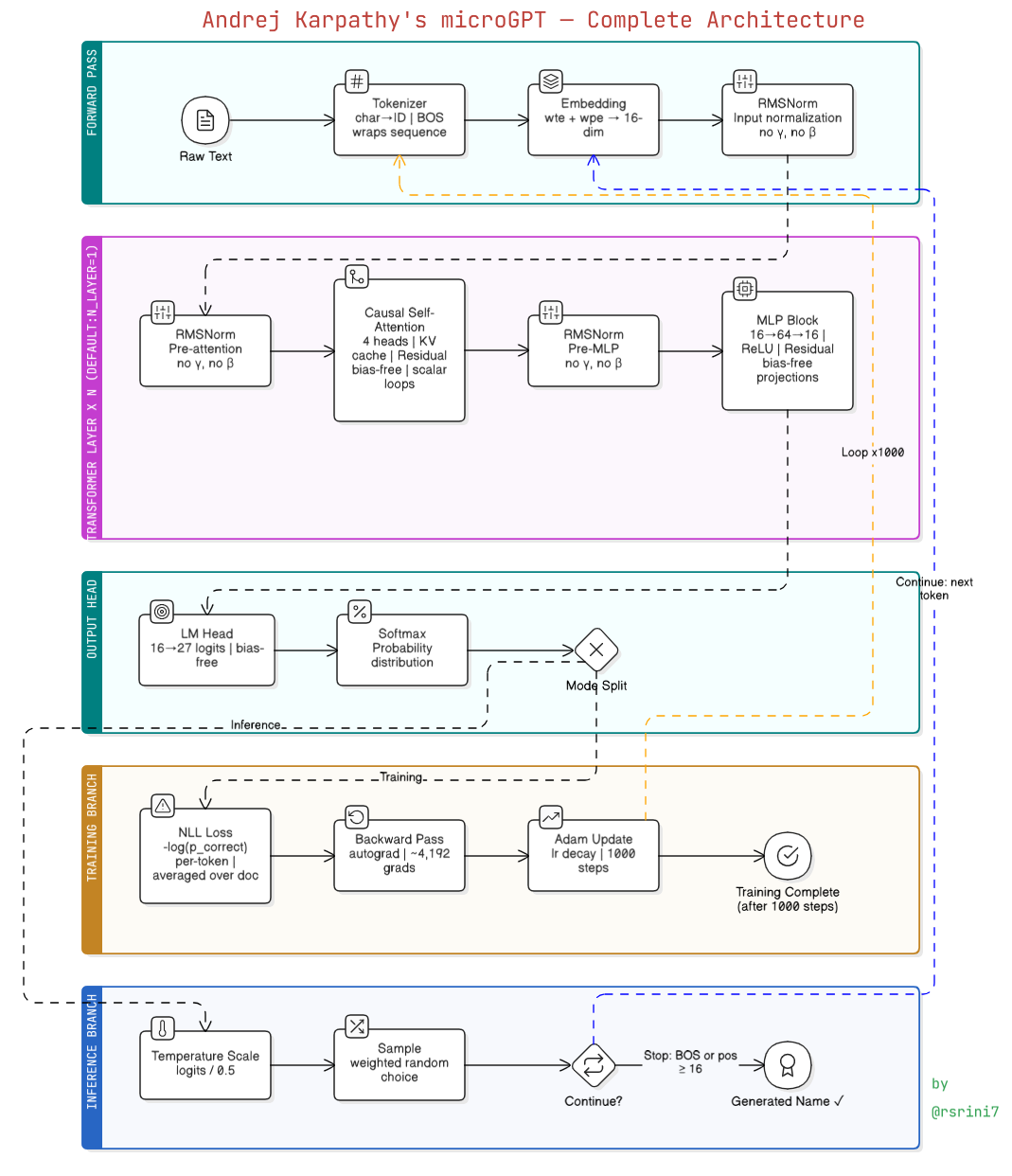
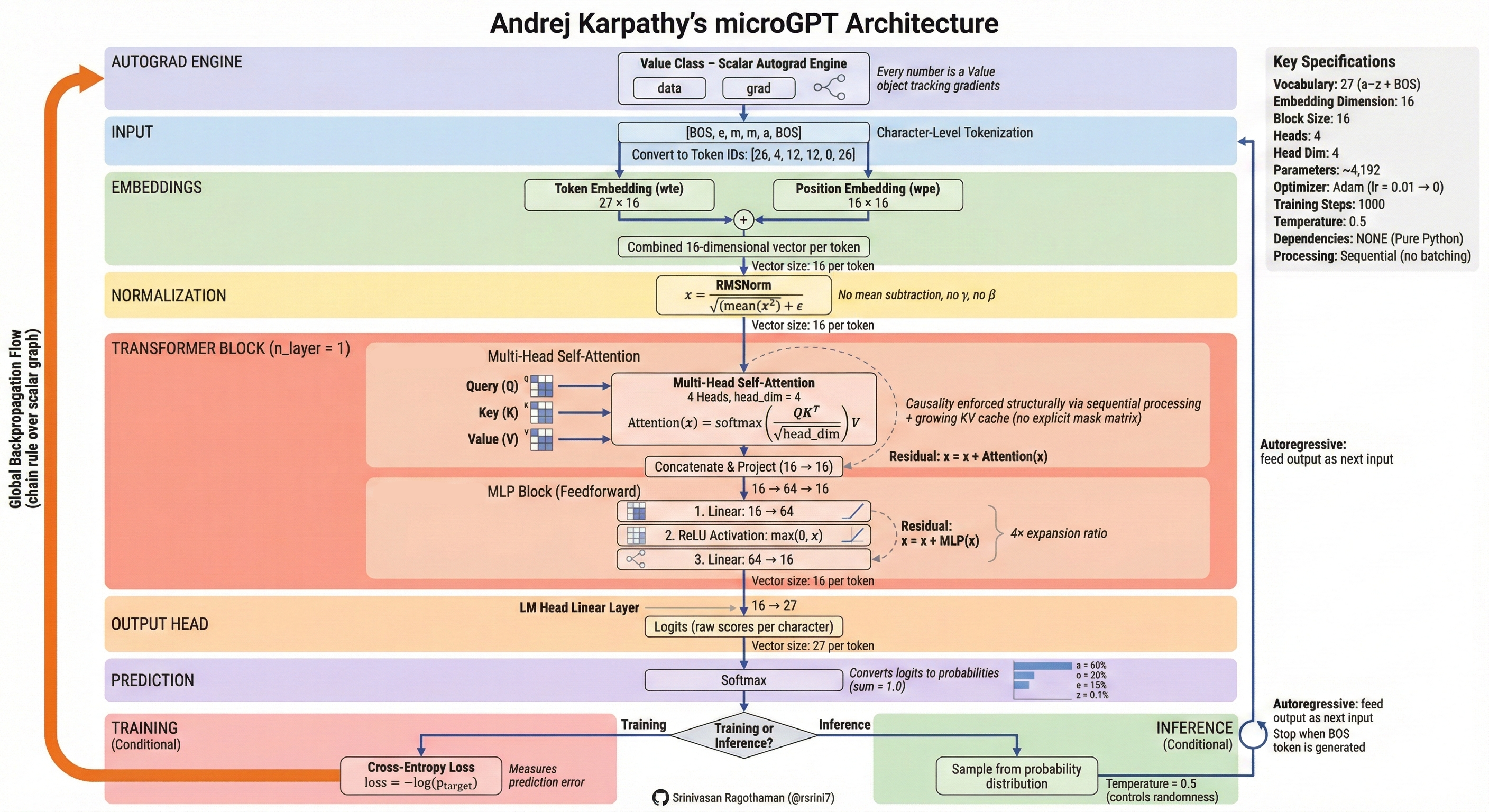
flowchart TD
    A["📄 Raw Text<br/> (names.txt / shakespeare)"] --> B["🔤 Tokenizer<br/> Char → ID"]
    B --> C["📦 Embeddings<br/> Token + Position"]
    C --> D1["📐 RMSNorm ①<br/> After Embedding"]
    D1 --> D2["📐 RMSNorm ②<br/> Before Attention"]
    D2 --> E["🔍 Causal Self-Attention<br/> 4 Heads, KV Cache"]
    E --> D3["📐 RMSNorm ③<br/> Before MLP"]
    D3 --> F["🧠 MLP Block<br/> 16 → 64 → 16"]
    F --> G["📊 LM Head<br/> Logits (27 scores)"]
    G --> H["📈 Softmax<br/> Probabilities"]
    H -->|Training| I["⚖️ Loss + Backprop<br/> → Adam Update"]
    H -->|Inference| J["🎲 Sample<br/> Next Character"]
    J -->|Loop until BOS| J
The script begins by ensuring input.txt exists, defaulting to a dataset of names. Each line (name) is treated as an individual document and shuffled so the model learns character patterns — not a fixed ordering.
if not os.path.exists('input.txt'):
    # downloads names.txt ...
docs = [l.strip() for l in open('input.txt').read().strip().split('\n') if l.strip()]
random.shuffle(docs)This is not a fancy library tokenizer. It finds every unique character in the text and uses that as the vocabulary.
uchars = sorted(set(''.join(docs)))
BOS = len(uchars)   # Beginning of Sequence token (also acts as End-of-Sequence)
vocab_size = len(uchars) + 1
A special BOS token is added — it serves as both the start signal during generation and the stop signal when it's sampled as output.
Example:
"emma" → [BOS, e, m, m, a, BOS] → [26, 4, 12, 12, 0, 26]
flowchart LR
    T["'emma'"] --> C1["e → 4"]
    T --> C2["m → 12"]
    T --> C3["m → 12"]
    T --> C4["a → 0"]
    BOS1["BOS → 26"] --> E
    C1 --> E["[26, 4, 12, 12, 0, 26]"]
    C2 --> E
    C3 --> E
    C4 --> E
    BOS2["BOS → 26"] --> E
Each token ID gets two 16-dimensional vectors that are added together to form one input vector:
| Embedding | Weight Matrix | Encodes |
|---|---|---|
| Token Embedding (wte) | state_dict['wte'][token_id] |
What this character is |
| Position Embedding (wpe) | state_dict['wpe'][pos_id] |
Where this character sits in the sequence |
flowchart LR
    TID["token_id = 4 (e)"] --> WTE["wte lookup<br/> → 16-dim vector"]
    PID["pos_id = 1"] --> WPE["wpe lookup<br/> → 16-dim vector"]
    WTE --> ADD["➕ Element-wise Add"]
    WPE --> ADD
    ADD --> X["x: input vector<br/> [16 floats]"]
wte — Token Embedding Table
It encodes "What" — the identity of the character itself. Each character in the vocabulary gets its own unique 16-dimensional vector. So "e" always starts with the same base vector regardless of where it appears in a word. It's looked up by token_id.
tok_emb = state_dict['wte'][token_id] # "who is this character?"wpe — Position Embedding Table
It encodes "Where" — the position of the character in the sequence. Position 0 has its own 16-dim vector, position 1 has another, and so on up to block_size. This tells the model where in the sequence the current character sits.
pos_emb = state_dict['wpe'][pos_id] # "where in the sequence?"Together:
x = [t + p for t, p in zip(tok_emb, pos_emb)]They are element-wise added to produce one combined 16-dim vector that carries both pieces of information — identity + position — before being passed into the Transformer. Without wpe, the model would treat "e" at position 1 the same as "e" at position 5, losing all sense of word structure.
microGPT uses a pre-norm Transformer design: RMSNorm is applied before each sublayer (attention and MLP) inside each Transformer block, plus once at input after the combined embedding. This keeps values in a stable range and prevents exploding/vanishing gradients.
x = rmsnorm(x)            # at input — after embedding, before the layer block
# inside each layer:
x = rmsnorm(x)            # before attention sublayer
x = rmsnorm(x)            # before MLP sublayer
Formula: x / sqrt(mean(x²) + ε)
Important: This RMSNorm has no learnable parameters — no scale (γ) or shift (β). Unlike LayerNorm, it is purely a normalization operation with nothing added to
state_dict.
Value is the minimal building block that replaces PyTorch's entire autograd system. Every scalar number in the model — both weights and intermediate activations — is wrapped in a Value object. Each Value stores three things: its scalar data, its gradient (.grad), and links to its parent nodes (children and local_grads) so the computation graph can be traversed.
class Value:
    def __init__(self, data, children=(), local_grads=()):
        self.data = data       # the scalar value
        self.grad = 0          # gradient accumulates here during backward()
        self._children = children       # parent nodes in the graph
        self._local_grads = local_grads # local derivative w.r.t. each parent
    def backward(self):
        # reverse topological sort + chain rule
flowchart LR
FWD["Forward Pass<br/> Every math op on Values<br/> builds the graph"] --> GRAPH["🕸️ Computation Graph<br/> (Values linked via children/local_grads)"]
GRAPH --> BWD["loss.backward()<br/> Walk in reverse<br/> topological order"]
BWD --> GRAD["Gradients accumulate<br/> in each node's .grad<br/> (~4,192 total)"]
GRAD --> ADAM["Adam reads .grad<br/> to update weights"]
- Forward pass: every math operation (
+,*,log, etc.) records its inputs aschildrenand stores the local derivative aslocal_grads, building the graph automatically. - Backward pass:
loss.backward()performs a reverse topological sort of the entire graph and walks it in reverse, applying the chain rule at each node. The gradient of the loss with respect to each parameter accumulates in.grad. - Adam then reads
.gradfrom every parameterValueto perform the weight update — this is the bridge between autograd and the optimizer.
Before the model can run, all learnable weight matrices must be created and stored in a state_dict dictionary. There are four core model size hyperparameters that together determine total model capacity:
| Hyperparameter | Value | Controls |
|---|---|---|
n_embd |
16 | Width of every vector representation |
n_head |
4 | Number of attention heads |
n_layer |
1 | Depth — how many Transformer blocks |
block_size |
10 | Maximum sequence length the model trains on at once |
block_size deserves special attention. Each document is one line from input.txt. If lines are very short (like names: 3–8 characters), block_size rarely becomes a limiting factor — the whole name fits within it easily. But if lines are long (like Shakespeare passages), block_size controls how much of the line the model can see as context at any one position. A small block_size means the model only ever sees a short window, which is a direct reason it cannot learn long-range patterns — it never has access to context from far back in the sequence. This is explicitly why the Shakespeare experiment produces words and local formatting but lacks real structural memory.
Every matrix is seeded with small random numbers via a helper matrix() function that returns a 2D list of Value objects.
n_embd   = 16   # embedding dimension
n_head   = 4    # attention heads
n_layer  = 1    # transformer layers
block_size = 10 # max sequence length

state_dict = {
    'wte': matrix(vocab_size, n_embd),   # token embedding table
    'wpe': matrix(block_size, n_embd),   # position embedding table
}
for i in range(n_layer):
    state_dict[f'layer{i}.attn_wq'] = matrix(n_embd, n_embd)  # Query projection
    state_dict[f'layer{i}.attn_wk'] = matrix(n_embd, n_embd)  # Key projection
    state_dict[f'layer{i}.attn_wv'] = matrix(n_embd, n_embd)  # Value projection
    state_dict[f'layer{i}.attn_wo'] = matrix(n_embd, n_embd)  # Output projection
    state_dict[f'layer{i}.mlp_fc1'] = matrix(n_embd, n_embd * 4)  # MLP expand
    state_dict[f'layer{i}.mlp_fc2'] = matrix(n_embd * 4, n_embd)  # MLP contract
state_dict['lm_head'] = matrix(n_embd, vocab_size)             # final classifier
flowchart LR
DIM["Dimensions<br/> n_embd=16, n_head=4"] --> WTE["wte<br/> vocab_size × 16"]
DIM --> WPE["wpe<br/> block_size × 16"]
DIM --> ATT["Attention matrices<br/> wq, wk, wv, wo<br/> (each 16 × 16)"]
DIM --> MLP["MLP matrices<br/> fc1: 16 × 64<br/> fc2: 64 × 16"]
DIM --> LMH["lm_head<br/> 16 × vocab_size"]
WTE & WPE & ATT & MLP & LMH --> SD["state_dict<br/> ~4,192 total params"]
All matrices are bias-free. Every linear projection in this model computes only
Wx— there is no+ bterm anywhere. Theparamslist flattens allValueobjects fromstate_dictfor the optimizer to iterate over.
The gpt function is the Transformer. It processes one token at a time — there is no batching, no batch dimension, no parallel sequence processing. This single-token-at-a-time design is exactly why causality is structural: the KV cache simply hasn't seen future tokens yet when the current one is processed.
All linear projections (Q, K, V, attn_wo, mlp_fc1, mlp_fc2, lm_head) are bias-free — the
linear()function computes onlyWx, neverWx + b. This matches modern GPT design.
def gpt(token_id, pos_id, keys, values):
    tok_emb = state_dict['wte'][token_id]
    pos_emb = state_dict['wpe'][pos_id]
    x = [t + p for t, p in zip(tok_emb, pos_emb)]
    x = rmsnorm(x)
# ... Attention and MLP blocks ...flowchart TD
X["Input x [16-dim]"] --> Q["Query (Q)<br/> 'What am I looking for?'"]
X --> K["Key (K)<br/> 'What info do I have?'"]
X --> V["Value (V)<br/> 'What do I share?'"]
Q --> SCORE["Attention Scores<br/> Q·Kᵀ / √(head_dim)"]
K --> SCORE
SCORE --> SOFT["Softmax → weights<br/> ⚠️ No mask tensor — KV cache<br/> only holds past positions<br/> (implicit causality)"]
SOFT --> OUT["Weighted sum of Values"]
V --> OUT
OUT --> HEADS["4 Heads concatenated<br/> (each head: 4-dim output)<br/> 4 × 4 = 16-dim total"]
HEADS --> PROJ["attn_wo: Linear 16 → 16<br/> (output projection)"]
X --> RES["➕ Residual Connection<br/> x = x + Attention(x)"]
PROJ --> RES
Key insight on causality: There is no explicit masking matrix. Causality is enforced structurally — at position 5, the KV cache only contains entries from positions 0–4 because they haven't been processed yet.
keys[li].append(k)
values[li].append(v)
# Scores are only computed over the keys seen so far
attn_logits = [sum(q_h[j] * k_h[t][j] for j in range(head_dim))
               for t in range(len(keys[li]))]
Head dimension arithmetic: head_dim = n_embd // n_head = 16 // 4 = 4. Each of the 4 heads independently attends over its own 4-dimensional slice of Q, K, V. Their outputs are concatenated back to 16 dims, then passed through attn_wo (a 16×16 linear projection) before the residual add.
Implementation note: There are no tensor matmul operations. Attention scores are computed via explicit Python loops over scalars: sum(q_h[j] * k_h[t][j] for j in range(head_dim)). Everything is scalar arithmetic on Value objects.
flowchart LR
    X16["x [16-dim]"] --> FC1["Linear: 16 → 64"]
    FC1 --> RELU["ReLU<br/> (negatives → 0)"]
    RELU --> FC2["Linear: 64 → 16"]
    FC2 --> RES["➕ Residual<br/> x = x + MLP(x)"]
    X16 --> RES
The expansion to 64 dimensions gives the model more "room to think" before compressing back.
flowchart LR
    X16["x [16-dim]"] --> HEAD["Linear projection<br/> 16 → 27 logits"]
    HEAD --> SOFT["Softmax"]
    SOFT --> PROBS["Probabilities<br/> 'a':60%, 'o':20%, 'z':0.1%..."]
The 27 scores (one per character in the vocabulary) are converted to a probability distribution that sums to 100%.
Task: Next Token Prediction. If the model sees "J", it tries to predict "e" for "Jeffrey".
On each training step, one document (one line) is picked from docs. It is tokenized as [BOS] + characters + [BOS]. The number of positions actually trained is:
n = min(block_size, len(doc_tokens) - 1)This caps training at block_size even if the document is longer, and subtracts 1 because next-token prediction needs a target at t+1 for every input at t. After the forward pass, loss is averaged across all positions in that document, gradients are computed, Adam updates the weights, and gradients are reset to zero before the next document.
losses = []
for pos_id in range(n):
    token_id, target_id = tokens[pos_id], tokens[pos_id + 1]  # current → next
    logits = gpt(token_id, pos_id, keys, values)
    probs = softmax(logits)
    loss_t = -probs[target_id].log()   # .log() is autograd-aware: defined on the Value class
    losses.append(loss_t)
loss = (1 / n) * sum(losses)           # per-token loss averaged across the document slice
flowchart TD
A["Step 1–7: Forward Pass<br/> → probabilities"] --> L["Step 8: Compute Loss<br/> -log(P(correct char))<br/> High surprise = High loss"]
L --> B["Step 9: Backpropagation<br/> Autograd traces graph<br/> → 4,192 gradients"]
B --> O["Step 10: Adam Update<br/> Nudge weights → lower loss"]
O -->|Next token| A
Loss intuition: If the model predicts the correct next character with low confidence → loss is high. Perfect confidence → loss approaches 0.
lr_t = learning_rate * (1 - step / num_steps)  # linear decay
for i, p in enumerate(params):
    m[i] = beta1 * m[i] + (1 - beta1) * p.grad        # 1st moment (mean)
    v[i] = beta2 * v[i] + (1 - beta2) * p.grad ** 2   # 2nd moment (variance)
    m_hat = m[i] / (1 - beta1 ** (step + 1))           # bias correction
    v_hat = v[i] / (1 - beta2 ** (step + 1))           # bias correction
    p.data -= lr_t * m_hat / (v_hat ** 0.5 + eps_adam) # weight update
    p.grad = 0                                          # zero out gradient
flowchart LR
G["Gradient p.grad"] --> M["1st Moment Buffer m<br/> (smoothed mean)"]
G --> V["2nd Moment Buffer v<br/> (smoothed variance)"]
M --> ADAM["Adam Update<br/> w = w - lr * m̂/√v̂"]
V --> ADAM
ADAM --> W["Updated Weight"]
The moment buffers act as memory for training — they smooth out updates so learning doesn't wobble, ensuring convergence.
- Learning rate starts at
0.01and follows linear decay to 0:lr_t = 0.01 × (1 − step/1000). Gradient is zeroed after each update (p.grad = 0) since theValueengine accumulates.
temperature = 0.5  # controls randomness: low = conservative, high = creative
for pos_id in range(block_size):
    logits = gpt(token_id, pos_id, keys, values)
    probs = softmax([l / temperature for l in logits])  # temperature applied to logits BEFORE softmax
    token_id = random.choices(range(vocab_size), weights=[p.data for p in probs])[0]
    if token_id == BOS:
        break  # Stop if it predicts the end
Note on temperature: dividing logits by a value < 1 sharpens the distribution (more confident), while > 1 flattens it (more random). The source uses
temperature = 0.5by default.
flowchart TD
    START["Start: BOS token"] --> FWD["Forward Pass<br/> → probabilities"]
    FWD --> SAMPLE["Sample next character<br/> (weighted random)"]
    SAMPLE --> CHECK{Is it BOS<br/> or max length?}
    CHECK -->|No| APPEND["Append to sequence"]
    APPEND --> FWD
    CHECK -->|Yes| OUT["Output generated name<br/> e.g. 'emma', 'oliver'"]
Inference is identical to the forward pass during training — but no loss is calculated and no weights are updated. The model "babbles" by feeding its own output back in as the next input (autoregressive generation).
sequenceDiagram
    participant D as Data
    participant T as Tokenizer
    participant M as Model (gpt)
    participant A as Autograd
    participant O as Adam

    D->>T: Raw characters
    T->>M: Token IDs [BOS, e, m, m, a]
    loop For each position
        M->>M: Embed + Norm + Attention + MLP
        M->>A: Logits → Loss
        A->>A: backward() — compute all gradients
        A->>O: Gradients for 4,192 params
        O->>M: Updated weights
    end
    M-->>D: Repeat for 1,000 steps
| Experiment | Result |
|---|---|
| 1,000 steps on names | Learns basic name structures — common endings, typical lengths |
| 10,000 steps on names | No clear improvement over 1,000 steps — the task is simple enough that the model saturates quickly |
| Shakespeare (small model) | Produces basic short words, punctuation, and line breaks, but not real Shakespeare |
What the Shakespeare model learns vs misses:
It picks up surface patterns — common short words ("the", "me", "and"), punctuation placement, and line break frequency. What it completely misses is deeper structure: multi-line continuity, rhythmic meter, long-range phrasing, and dramatic coherence. There are three compounding reasons for this:
block_size = 10— the model never sees more than 10 characters at once, so long-range context is structurally inaccessible- Each line is treated as a separate document — the model has no continuity between lines; every line is an isolated training example, so it never learns cross-line patterns
- Tiny capacity — 1 layer, 16-dim embeddings, ~4,192 parameters total is far too small to internalize Shakespeare's vocabulary and structure
Scaling note: Larger GPTs increase
n_layer,n_embd,block_size, andvocab_size— but the core algorithm here is identical. Everything else is just efficiency.
The entire architecture runs on pure Python scalars. Every number is wrapped in a custom
Valueobject that tracks both its value and its gradient, building a computation graph that enables learning via the chain rule.
Characters get personalities (embeddings)
    → talk to each other (attention)
    → think deeply (MLP)
    → predict what comes next (LM head + softmax)
    → learn from mistakes (loss + backprop + Adam)
    → repeat
Based on Andrej Karpathy's microGPT implementation.

Andrej Karpathy Posts:
https://karpathy.github.io/2026/02/12/microgpt/
https://gist.github.com/karpathy/8627fe009c40f57531cb18360106ce95
https://x.com/karpathy/status/2021694437152157847
My Reddit Post: https://www.reddit.com/r/learnmachinelearning/comments/1r3qaky/andrej_karpathys_microgpt_architecture_stepbystep/
Youtube Reference : https://www.youtube.com/watch?v=vAaIKoRE1-o
Dev.to Post: https://dev.to/rsrini7/andrej-karpathys-microgpt-architecture-complete-guide-em8