Skip to content

Instantly share code, notes, and snippets.

@misostack
Last active December 20, 2025 07:21
Show Gist options
  • Select an option

  • Save misostack/baa7797e2a0b201f74d703db8450fdbe to your computer and use it in GitHub Desktop.

Select an option

Save misostack/baa7797e2a0b201f74d703db8450fdbe to your computer and use it in GitHub Desktop.
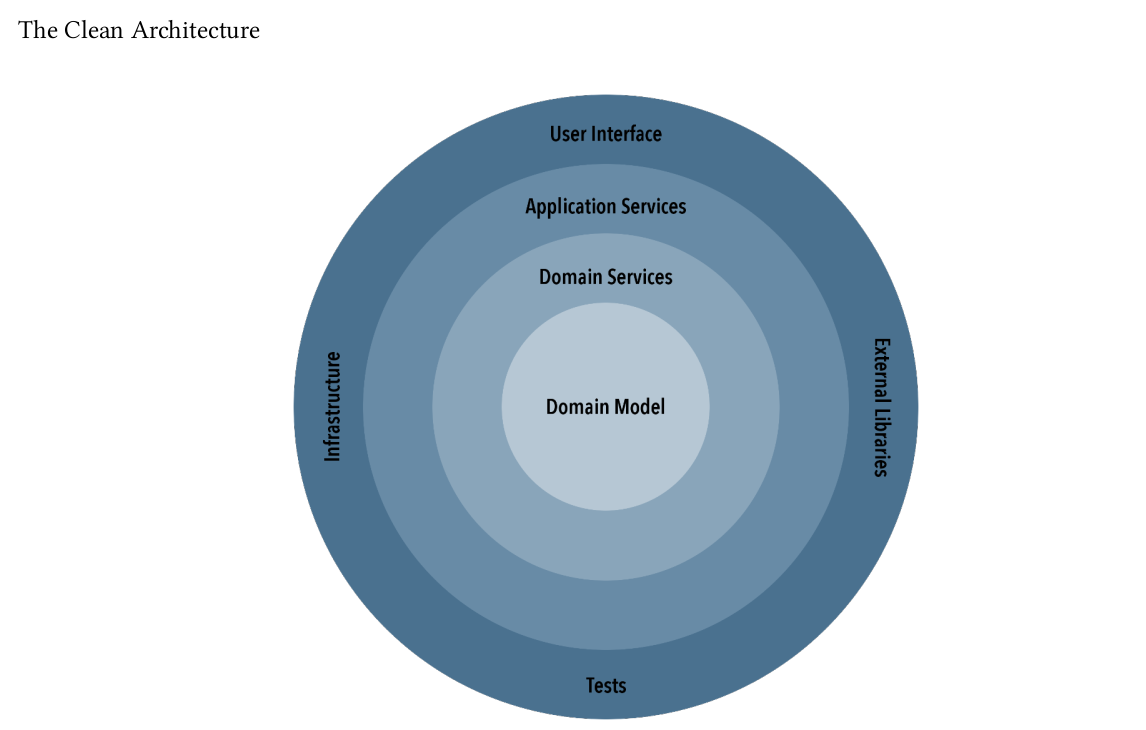
Clean Architecture

Clean Architecture

image

1. What is architecture?

Architecture is simply a set of attributes about how your code is laid out, organized, and how it interacts with other pieces or layers of the code.

Eg: MVC architecture

2. Layers of Software

Layers, in object oriented programming, are groups of specific classes that perform the similar functions

Usually, layers are broken up by concerns, which is a particular set of function or information. Our concerns can be many, depending on the application, but can include: database interaction, business rules, API interactions, or the view, or UI.

3. Good Architecture

  1. Testable
  2. Easy to Refactor
  3. Possible to Upgrade
  4. Reusable
  5. Less dependencies: Use Dependency Injection, Use Interfaces, not Concrete Classes, Use Adapters

4. Decoupling toolbox

Design Patterns, A Primer : A design pattern is a specific solution to a commonly occurring problem in software development. There are more than twenty three design patterns organized into three categories: Creational, Structural, and Behavioral

1.Factory

An object responsible for instantiating other objects

2.Repository

Not actually a GoF design pattern, this is an object responsible for transitioning data to and from its storage

3.Adapter

An object that encapsulates another object to make it conform to a desired API

4.Strategy

Encapsulates a behavior or a set of behaviors, allowing them to be used interchangeably

@misostack
Copy link
Author

image

@misostack
Copy link
Author

image

@misostack
Copy link
Author

Simple software requirements:

  1. Ability to add new customers.
  2. Ability to create simple orders to customers.
  3. Ability to run an Invoicing process that turns Orders into Invoices when it’s time to bill the customer.

@misostack
Copy link
Author

Customers:

  • email - required, unique . Format : email format
  • firstName ( required ), lastName (optional), fullname( computed field )
  • dateOfBirth ( optional - date ). Format: yyyy/mm/dd
  • phoneNumber (optional, unique ) . Format : Vietnam phone number format
  • customerId ( required, unique ) . Format: YYMMDD-UUID
  • createdAt ( datetime, auto generated ). Format : UTC
  • updatedAt( datetime, auto generated ). Format : UTC
  • status ( PENDING, ACTIVE, INACTIVE, ARCHIVED )

@misostack
Copy link
Author

misostack commented Jan 25, 2021

Orders:

  • orderId ( YYMMDD-UUID )
  • createdAt (datetime, auto generated). Format : UTC
  • updatedAt (datetime, auto generated). Format : UTC
  • status ( DRAFT, PENDING, VALIDATED, DELIVERING, DELIVERED, POSTPONE, RETURNED, COMPLETED )
  • customerId ( foreign key )
  • DeliveryDate
  • Note
  • ShippingAddress
  • PaymentStatus ( UNPAID, PAID, CANCELLED )

Product:

  • ProductID
  • Name
  • Price

Order details:

  • ProductID
  • ProductName
  • Quanlity
  • Notes
  • OrderId ( Foreign key )

@misostack
Copy link
Author

misostack commented Jan 25, 2021

Invoices:

  • invoiceId (YYMMDD-UUID)
  • createdAt ( datetime, auto generated). Format : UTC
  • updatedAt ( datetime, auto generated). Format : UTC
  • status ( pending, accepted, cancelled )
  • orderId
  • customerId
  • note
  • payment Status ( unpaid, paid, cancelled )

Sign up for free to join this conversation on GitHub. Already have an account? Sign in to comment
